
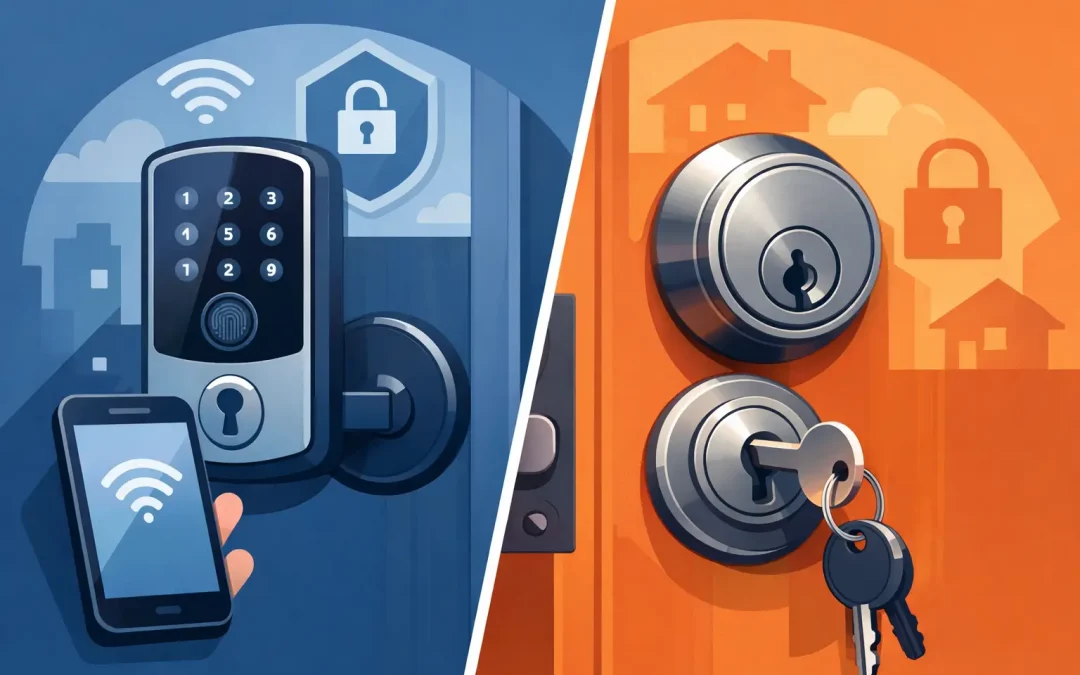
You usually start thinking about smart locks versus deadbolts after something has already gone wrong. A lost key, a stiff front door, a tenant changeover, or that uneasy feeling after a break-in nearby. When security suddenly matters more than ever, the choice is not just about what looks modern. It is about what will protect your property properly and what will still work when you need it most.
For most homes and businesses in Wallsend and across the North East, there is no single answer that suits everyone. Some properties benefit from the simplicity and proven strength of a traditional deadbolt. Others need the extra control and convenience that a smart lock can offer. The right choice depends on the door, the building, who needs access, and how much day-to-day hassle you want to avoid.
Smart locks versus deadbolts: what is the real difference?
A deadbolt is a mechanical lock designed to secure a door with a solid metal bolt. It is straightforward, familiar, and widely trusted. When fitted correctly to a strong door and frame, a good deadbolt is still one of the most dependable ways to secure an entrance.
A smart lock adds electronic control. Depending on the model, you might open it with a code, phone app, fingerprint, key fob, or a physical key as backup. Some smart locks replace a traditional lock completely, while others work alongside an existing deadbolt.
That last point matters. Plenty of people compare the two as if they are always opposites, but in practice some smart lock setups still rely on a deadbolt mechanism. The real question is often less about old versus new, and more about how you want access to be managed.
Where deadbolts still come out strong
Deadbolts remain popular because they do one job well. They secure a door without batteries, apps, Wi-Fi, or software updates. For many homeowners, that simplicity is a major advantage.
If you want a front door lock that is reliable, cost-effective, and easy to understand, a deadbolt is hard to fault. There is less to go wrong electronically, and quality mechanical locks can last for years with proper fitting and maintenance. That makes them a sensible choice for owner-occupied homes, smaller offices, side entrances, and properties where only a few people need keys.
They also suit customers who do not want to rely on a phone to get indoors. If your priority is solid physical security with minimal fuss, a properly installed deadbolt is still a very good option.
That said, deadbolts are not automatically high security just because they are traditional. A cheap lock fitted badly into a weak frame will never perform like a quality lock installed properly. The surrounding door, hinges, strike plate, and frame condition all matter just as much.
Why smart locks appeal to busy households and businesses
Smart locks solve a different set of problems. They are less about replacing strength and more about improving control.
If you have ever hidden a spare key, waited in for a delivery, needed to let in a cleaner, or worried about how many old keys are still out there after a tenant moved on, the appeal is obvious. A smart lock can let you issue temporary codes, track access, and change permissions without changing the whole lock every time.
For landlords, holiday lets, small businesses, and households with teenagers or older relatives, that flexibility can be genuinely useful. You can avoid key copying, reduce lockouts caused by forgotten keys, and manage access faster when circumstances change.
Some smart locks also help with routine forgetfulness. If you cannot remember whether you locked the door, app-based status checks and auto-lock features can offer peace of mind. For many people, that convenience is the main selling point.
Security is not just about the lock type
When customers ask which is safer in the smart locks versus deadbolts debate, the honest answer is that it depends on the product and the installation.
A high-quality deadbolt fitted to a strong timber or composite door can offer excellent physical protection. A poor one will not. The same goes for smart locks. A well-made smart lock from a reputable manufacturer, with proper fitting and sensible user settings, can be very secure. A badly chosen model on a weak door is a different story.
Smart locks introduce extra considerations. You need to think about battery life, software support, and how the lock behaves if your phone is flat or the internet drops out. Many models are designed with fallbacks such as key override, emergency power contact points, or keypad entry, but not all setups are equal.
A deadbolt has fewer moving parts in that sense. It is less vulnerable to digital issues simply because it is not digital. But it can still fail through wear, poor fitting, corrosion, misalignment, or forced damage.
Security is always a chain. The lock matters, but so does the way the whole door set works together.
Cost, maintenance and long-term value
Deadbolts are usually cheaper to buy and fit than smart locks. If budget is a major concern, that can make the decision simpler.
A standard mechanical deadbolt is often the most affordable route for straightforward home security upgrades. Maintenance is also generally lighter. Keep it aligned, keep it clean, and deal with wear before it turns into a failure.
Smart locks cost more upfront. You are paying for electronics, access features, and in some cases app integration or subscription-based functions. They may also need battery changes and occasional troubleshooting. If the convenience saves time, avoids rekeying, or makes access management easier, the extra cost may be worth it. If you only use one key and rarely need to share access, it may not be.
That is why smart locks often make more sense where access changes regularly. For a rental property, office, or multi-user household, they can offer practical value beyond the purchase price. For a quiet home with one or two keyholders, a quality deadbolt may be the better use of money.
Smart locks versus deadbolts for different properties
For a typical family home, both options can work well. If convenience is high on your list and you like keypad or app access, a smart lock can be a good fit. If you want straightforward, proven security with no extra technology, a deadbolt remains a solid choice.
For landlords, smart locks can be especially useful between tenancies. Changing access without replacing physical keys can save time and reduce uncertainty. That said, not every rental property door is suitable for every smart lock, particularly where uPVC mechanisms or multi-point locking systems are involved.
For shops, offices and small commercial premises, access control often matters just as much as raw lock strength. Staff changes, cleaner access, and opening hours can make smart locks attractive. But many businesses still benefit from pairing electronic convenience with strong mechanical security.
Older doors, warped frames, and tired hardware can complicate both options. If the door already sticks or the lock is misaligned, fitting a new lock alone may not solve the problem. The condition of the door should always be assessed before deciding.
When a deadbolt is the better call
A deadbolt is often the better choice when you want reliability without complication, when multiple users are not an issue, or when the door setup does not suit a smart system. It also makes sense if you are wary of battery dependence or app-based control.
There is a lot to be said for a lock that simply turns and secures the door every time. In emergency locksmith work, simple systems often prove easier to maintain and less likely to confuse people under stress.
When a smart lock is worth it
A smart lock is worth considering when access needs to be flexible, when keys are regularly lost or shared, or when convenience is a real day-to-day benefit rather than just a novelty.
It can also suit customers upgrading security after a lockout or break-in scare, especially if they want more oversight over who comes and goes. Just make sure the product is suitable for your door and fitted correctly. A flashy lock with poor installation is not an upgrade.
The best answer is often a practical one
In many cases, the best setup is not choosing sides in smart locks versus deadbolts. It is choosing the right lock for the property and the people using it. Some homes need simple and strong. Some need flexible access. Some need both.
If you are replacing a damaged lock, securing a new property, or trying to make life easier without compromising safety, it helps to look at the full picture rather than chase trends. A good lock should match your routine, your door, and your security concerns.
If you are unsure, get the door and current hardware checked properly before spending money on the wrong solution. The best security upgrade is the one that works reliably when you shut the door behind you at the end of a long day.